What we’re learning.

Ideas, conversations and points of view on turning intelligence into outcomes.

We’re using AI with several clients and seeing 10x to 100x more knowledge work than their existing teams could previously cover. Yet they aren’t replacing any staff, and it isn’t a noble gesture from leaders. The reason is simpler than that.

With one client, we reviewed invoices from their facilities vendors. One invoice was for $2,500, far too small to earn a close look when attention goes to the big ones. It had passed the prior check, yet contained 5 discrepancies, including a $1,750 contract-rate error - 70% of its value! It wasn’t an outlier. Across hundreds of small invoices like it, similar findings added up to material savings and a firmer footing with vendors.
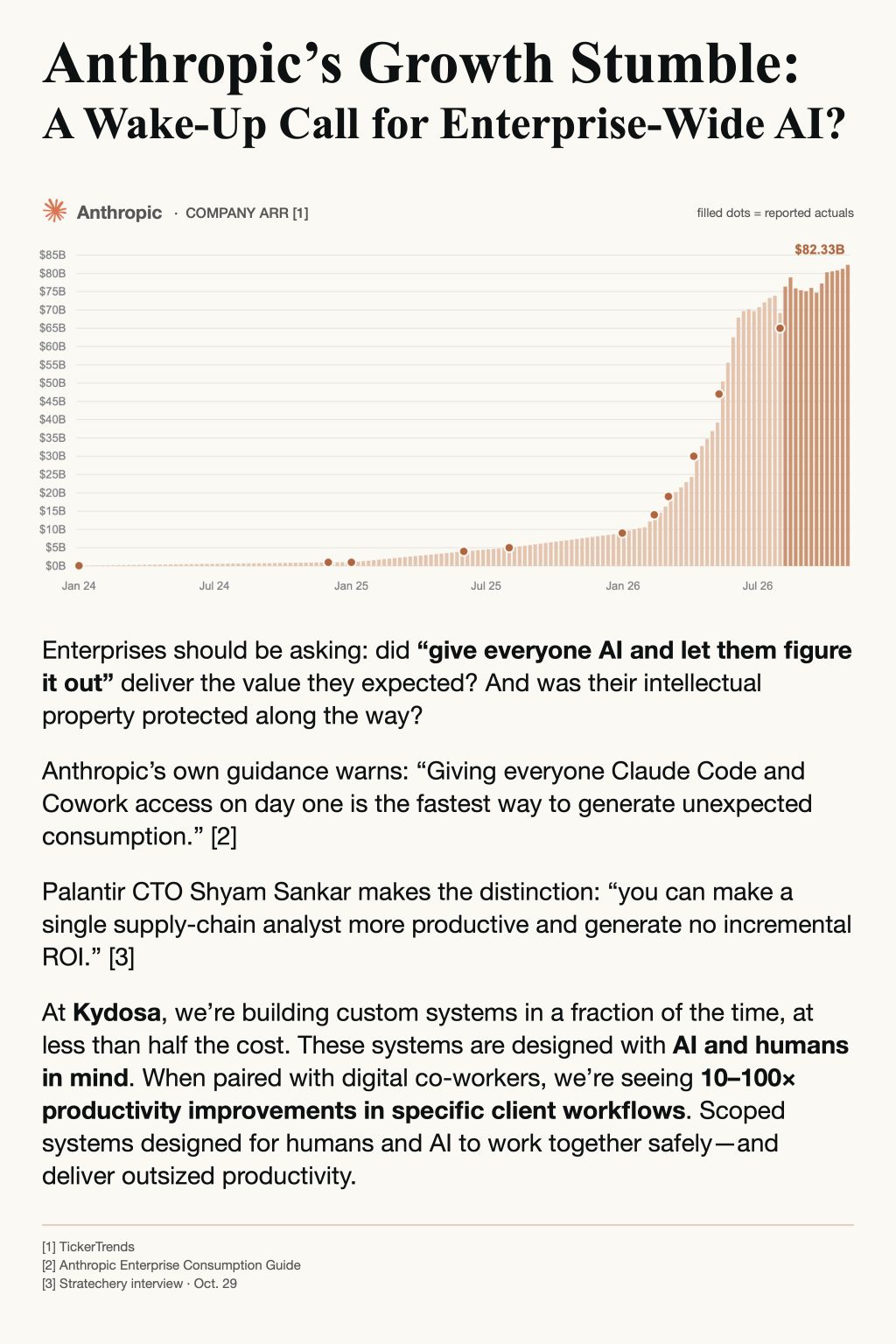
Enterprises should be asking: did “give everyone AI and let them figure it out” deliver the value they expected? And was their intellectual property protected along the way?

Anthropic’s own guidance warns: “Giving everyone Claude Code and Cowork access on day one is the fastest way to generate unexpected consumption.” [2]

Open-weight models are becoming a bigger part of the AI market, and they can already be the better choice for some of the most advanced tasks. For a particular job, the frontier may now be an open-weight model.

Anthropic’s slowing growth does not mean the market is not expanding. The pattern in Ava’s briefing tells us that we need to look beyond any single provider to understand where demand is going.

Ava highlights two shifts in the economics of AI. On Vercel’s AI Gateway, open-weight usage rose from 10% to 81% in five months: a gain of 71 percentage points. The token-price data shown in the video records a 53% fall over four months.

At Kydosa, we feel the edges of AI on real work every day. As Ava points out, safety training can make some models overthink. The best...

For 50 years, we’ve worked with software through keyboards and mice. Now that’s changing.

At Kydosa, we deploy digital workers (AI agents with a defined role) to help clients onboard. They connect to a company’s systems and now they join team calls!

When we first put agents in front of teams instead of individuals, it was on Slack. It was fascinating to see the interaction. People learned by watching colleagues question the agent, push back on its answers, and iterate with it. It drove adoption better than any training class.

But this is bigger than AI joining calls. This video demonstrates the new interface to software. It’s profound. We all know that communication is more than just an exchange of words; studies show that more than 50% is through body language. Our digital workers understand this – they communicate through...

What outcome do you want to achieve?

Let’s talk